Self-Managed vs Professional STR Management: How to Choose
Self-managed vs professional Airbnb management: compare costs, fees and control, see the break-even math and pick the right short-term rental model.
Updated October 2026. Written and reviewed by the STR Market Superhost team.
Every short-term rental owner eventually asks the same question: should I keep running this myself, or hand it to a professional? Self-management keeps every dollar of revenue and every decision in your hands. Professional management buys back your time, but it costs a meaningful share of your income.
There is no single right answer. The best model depends on how many properties you own, how close you live, how much time you have and whether you enjoy hosting. This guide compares self-management, co-hosting and full-service management side by side, shows the math on fees, and gives you a simple way to decide.
Quick answer: which model fits you
Self-manage if you own one or two properties, live nearby or can build a reliable local team, and enjoy hosting.
Use a co-host if you want to keep ownership of the listing and big decisions, but hand off daily messaging and coordination. Published co-host fees in our directory usually run 10% to 15% of revenue.
Use full-service management if you want a hands-off investment, live far away or own several properties. Published full-service fees usually run 20% to 35%.
Try a hybrid if you want the savings of self-management without doing everything: automate messaging with software, and pay a local cleaner and handyman directly.
A manager charging 20% of revenue needs to raise your revenue by about 25% just to leave you with the same net income (see the math below).
Photo: Greg Rosenke on Unsplash
Self-managed vs co-host vs full-service: side by side
Self-managing means you run the business directly. You own the listing, set the price, talk to guests and hire the people who clean and fix things.
What you handle
Listing creation, photos and optimization
Pricing and minimum-stay strategy
Guest messaging, check-in instructions and support during stays
Cleaning and maintenance coordination
Supplies, restocking and inventory
Permits, lodging taxes and insurance
Reviews and guest issues
Pros
You keep the revenue that would otherwise go to management fees.
Full control over the guest experience, pricing and house rules.
You learn the business, which makes you a better buyer and operator if you add properties later.
Direct guest relationships can bring repeat and direct bookings.
Cons
Guests message at all hours, and emergencies do not wait for a convenient time.
You are responsible for finding backups when a cleaner or handyman falls through.
It is harder to scale past a few properties without systems or staff.
Photo: Jonas Leupe on Unsplash
Professional management: a streamlined solution
A professional manager takes over the daily operations. Depending on the agreement, that can include marketing your listing on Airbnb, Vrbo, Booking.com and their own website, answering guests, screening bookings, scheduling cleaners and maintenance, and handling payments and owner statements.
What a good manager does
Marketing and booking: professional photos, listing copy, multi-channel distribution and pricing.
Guest communication: fast responses, screening and support during stays.
Cleaning and maintenance: scheduling turnovers between stays and coordinating repairs.
Financial management: collecting payments, tracking income and expenses and sending monthly owner statements.
Local compliance: helping with permits, lodging tax registration and neighbor issues, where included in the agreement.
Pros
Saves you the most time; you can own a rental far from where you live.
Experienced managers often have better systems for pricing, reviews and operations.
Local teams handle emergencies and turnovers without you.
Easier to grow a portfolio.
Cons
Fees usually take 20% to 35% of revenue, plus cleaning and maintenance costs.
Less control over pricing, house rules and who stays.
Quality varies widely between companies.
Contracts may include setup fees, notice periods or listing ownership terms.
The math: what a management fee really costs
Here is an illustrative example of a property earning $4,000 a month in revenue with $1,000 in monthly operating expenses. Your own numbers will differ, so plug in real figures before deciding.
Photo: Kelly Sikkema on Unsplash
Scenario
Monthly revenue
Expenses
Management fee
Net to owner
Self-managed
$4,000
$1,000
$0
$3,000
Co-host at 15%
$4,000
$1,000
$600
$2,400
Full-service at 20%, same revenue
$4,000
$1,000
$800
$2,200
Full-service at 20%, revenue up 25%
$5,000
$1,000
$1,000
$3,000
The last row shows the break-even point: at a 20% fee, a manager has to lift revenue by 25% for you to end up where you started. At 25%, the required lift is about 33%, and at 30% it is about 43%. If you value your time highly, or the manager can genuinely raise rates and occupancy, the fee can still be worth it. Just make sure you compare like with like, including what the percentage is charged on.
Hybrid options: the middle ground
Many owners do not choose one extreme. Common hybrid setups include:
Self-manage with automation: use a PMS to send messages, sync calendars and schedule cleaners, and a dynamic pricing tool to set rates. See our best Airbnb property management software guide.
Hire cleaners directly and keep guest communication yourself. Our Airbnb cleaning cost guide shows what local turnover crews charge.
Work with a local co-host for check-ins, emergencies and restocking while you handle pricing and messaging.
Outsource guest messaging to a virtual assistant team while you keep everything else.
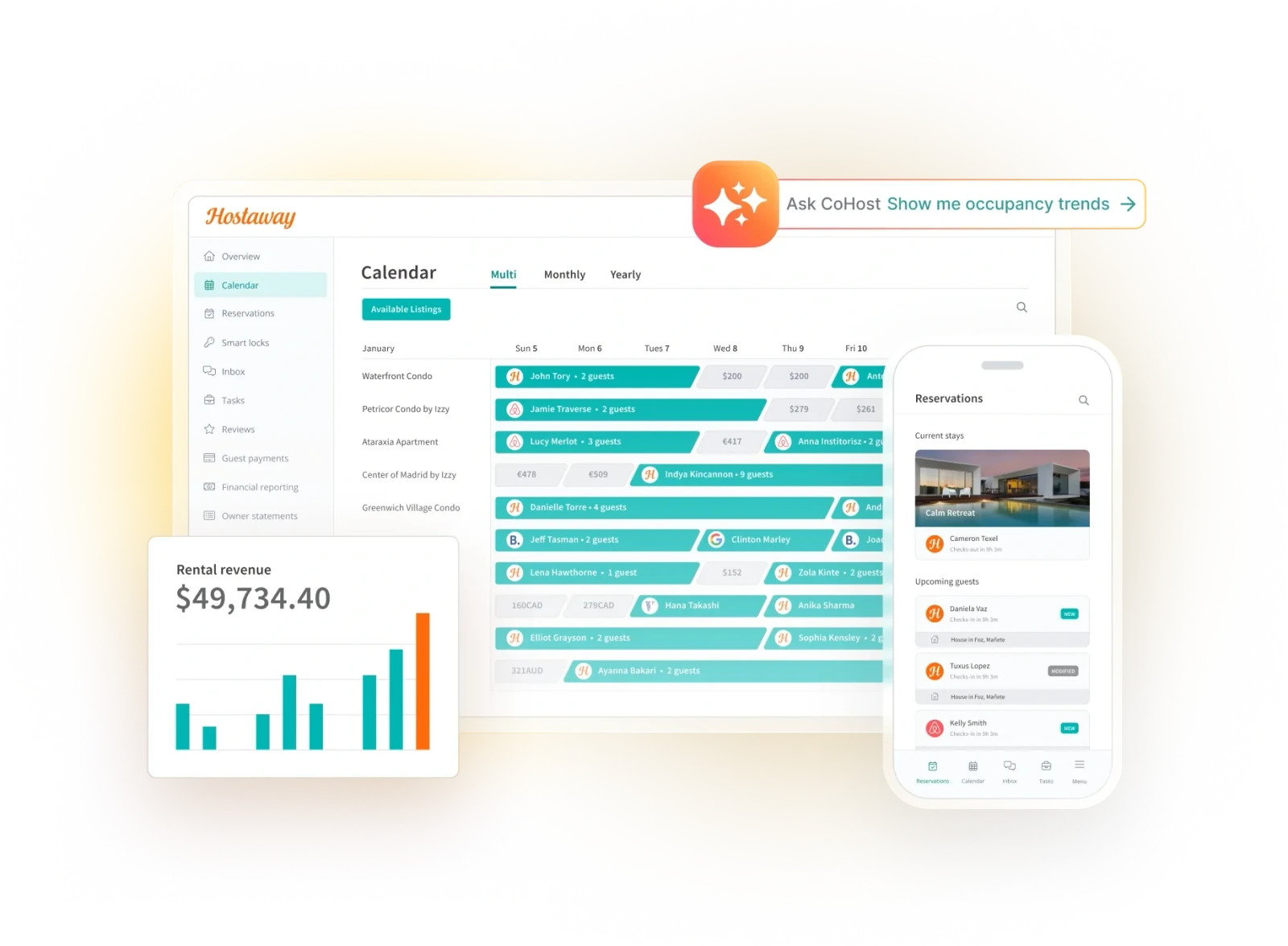
Image courtesy of Hostaway.
Tools that make self-management realistic include Hospitable (free plan; paid plans from $29/month), Hostaway (custom quote), Turno for cleaner scheduling (free, or $10/property/month with your own cleaners) and PriceLabs for pricing (from $19.99/listing/month). Smart locks remove the need for in-person key handoffs; see our best smart locks for Airbnb.
How to decide: five questions
How far do you live from the property? If you cannot get there within an hour or two, you need a reliable local person either way.
How many hours a week can you give it? Messaging, pricing, restocking and fixing problems add up, especially in peak season.
Do you enjoy hosting? Owners who like it tend to run better listings themselves.
How many properties do you own or plan to own? Self-management gets harder with each unit unless you build systems and staff.
Can a manager credibly raise your revenue? Ask for comparable listings they manage and their results before you assume they will.
How to choose a property manager or co-host
Experience and reputation: look for a local track record with short-term rentals and reviews from other owners, not only guests.
Transparent fees: get the fee base in writing (gross, nightly or net), plus setup, maintenance markups and cancellation terms.
Responsiveness: ask who answers guests at night and how fast they respond to neighbors.
Technology: they should use a modern PMS, dynamic pricing, smart locks and photo-verified cleaning.
Ownership terms: confirm who owns the listing and reviews if you part ways.
Compliance: ask who handles permits, licenses and lodging taxes in your market. Our Airbnb rules and taxes by city guide is a good starting point.
Signs it is time to switch models
You are self-managing and missing messages, double-booking or dreading every turnover.
Your reviews have dipped because of slow responses or cleaning issues.
You are paying a manager 25% or more and your revenue and reviews have not improved compared with similar listings.
You have moved away from the property, or you are adding more units than you can personally handle.
Frequently asked questions
Is it better to self-manage an Airbnb or hire a property manager?
Self-management usually earns more per property if you live nearby, have time and run it well. A property manager makes more sense if you live far away, own several properties or want a passive investment. Many owners choose a hybrid with software and a local co-host.
How much do Airbnb property managers charge?
In our directory, co-hosts typically publish 10% to 15% of revenue and full-service managers 20% to 35%, with cleaning and maintenance usually billed on top. Always check what the percentage is charged on.
How much more revenue does a manager need to generate to be worth it?
At a 20% fee on revenue, a manager needs to lift revenue by about 25% for your net income to stay the same, before counting the value of your time. At 25% the lift needs to be about 33%, and at 30% about 43%.
Can I self-manage an Airbnb from another state?
Yes, many owners do, but you need a reliable local cleaner, a handyman and someone who can respond in person to emergencies. Smart locks, noise monitors and a good PMS make remote hosting much easier.
What is the difference between a co-host and a property manager?
A co-host usually helps run your listing while you remain the owner of record, and charges a lower fee. A full-service property manager takes over operations entirely, often including their own booking channels, for a higher fee. On Airbnb, owners can add a co-host to the listing and split payouts automatically, as described in Airbnb's co-host payouts guide.